“… At that moment I actually sensed that it was no excuse to be young, and that it would have been possible to find things out." – Traudl Junge, one of Hitlers secrataries.
I am as self obsessed as the next person, possibly more as the very existence of this piece of literary flatulence proves that I regard the way I formulate words worthwhile. But this article is not about me, it is about Myspace. That once small, smelly, insignificant little spot on the arse of the internet which has grown to be as worrying, cancerous lump. It does more to insult the intelligence of the users than any one pornographic site or cellulite-based celebrity magazine does. It has gone from strength to strength on the basis of finding ways to encourage people to indulge their ego whilst ignoring what is really going on behind.
The first and most obvious reason to be anti-myspace is the man who owns it and the wider-company it belongs too. Rupert Murdoch is, to some, the devil incarnate and when he buys a company or participates in backing a political candidate (see Hilary Clinton and David Cameron as the current pair of those backed), the natural reaction for a lot of people is to raise one eyebrow, left or right, and question what is wrong with the company/person he is backing. So, when Murdoch bought Myspace for some $580 million, the warning bells went off – what is wrong with this place?
Throughout my childhood, SkyTV was a guilty pleasure for me & my brother but it was a dark cloud over my parents head. Slowly I started to eye Sky and the other News Corp products with a health scepticism. My father was a journalist and to him Rupert Murdoch had ruined the integrity that tabloids once held (and they did hold some integrity at one point) and pissed upon professional journalism, both on TV and in newspapers. His companies make a mockery out of the idea of freedom of the press through the way he controls what and how the news is reported through his TV channels and newspapers.
The Independent newspaper was set up in opposition to The Times for fear that when Murdoch bought it would become a flaccid shadow of its former self. It did. After a massive dispute in 1986, some reluctantly felt compelled to jump ship to the new formed Independent rather than remain with a once proud and now humiliated Times.
But, for all his media outlets, Murdoch felt he was loosing out on a new market called the internet, so he bought Myspace:
‘Young people "don't want to rely on a God-like figure from above to tell them what's important," Mr Murdoch said. “And to carry the religion analogy a bit further, they certainly don't want news presented as gospel. Instead, they want their news on demand, when it works for them. They want control over their media, instead of being controlled by it. They want to question, to probe, to offer a different angle”.’ (http://news.bbc.co.uk/1/hi/business/4697671.stm)
But Myspace is far from being a hub of information on demand and even less of a place “to question, to probe, to offer a different angle”. The ability to do such things on Myspace is reliant upon the fact that you, the user, has signed up to it and asked for been invited to receive the angle of information that the informer informs on. This encourages conformity and acceptance. Many other sites, not based on who is registered to them, actually have a more realistic chance of offering diversity of opinion without the author having chosen, to the same extent, the recipients. They have a more realistic chance of offering the ability “to question, to probe, to offer a different angle” because they do not require the reader to have already accepted the views of the author. But myspace is not about questioning and probing anyway, it is about keeping in touch with friends and showing off your ego … isn’t it?
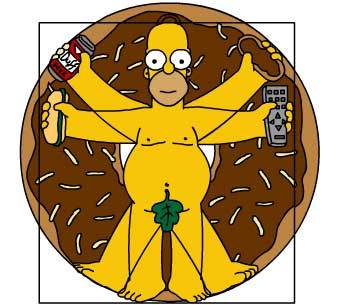
In fact Myspace pages have more in common with a website Homer Simpson creates in Foxs’ (another Murdoch company) The Simpsons in series 13, before he starts to report news. It is a little bit of the web personalised to promote the individuals taste in inane, silly things that they want people to look at except the counter has pictures of the lunatics who wish to be part of your tirade of dancing Jesuses and clock-work teeth.
Everything on there can be done better, more openly, more efficiently, more professionally and without as many restrictions. People can keep in contact with their friends more efficiently through other means. You can keep up to date with the music and film scenes more efficiently with real band webpages and ‘zines, both online and printed as well as in other formats. What these do not offer is the self inflating personal touch so that others can see how you would like to portray yourself.
Everything about Myspace is safe and comfortable in its conformity. What you can do with the space is varied but confined and you still have to have the adverts blaring at you and you have to conform to rules. You still have to act acceptably by standards set by someone else. There is still that “God-like figure from above to tell them what’s important” but now it’s in the guise of an infected nipple called Tom. Moreover the formula of Myspace can easily be manipulated for corporate gains.
The real reason Murdoch bought Myspace for $580 million is that it is a place to explore how to create revenue from online advertising and what markets can be targeted and how they can be targeted; an online test group. The illusion of diversity, discussion and information is, well, an illusion and what lies on top is a more easily built version of Homer’s website and what lies beneath is market research. Myspace is the test group and the target is whoever is signed up. Myspace is a place where Murdoch can find out how to target and manipulate the very smallest group. Yes, it would seem the plan is to sell youth to the youth.
http://observer.guardian.co.uk/review/story/0,6903,1028189,00.html
http://www.commondreams.org/views03/1023-02.htm
http://www.wired.com/wired/archive/14.07/murdoch.html

No comments:
Post a Comment